E-mu SP-1200
E-mu SP-1200
Avg. used price: ~£3,480(based on recent Reverb sales)

GearBook helps you research music gear prices. Compare sold prices across Reverb and eBay, see market trends, and find the best deals.
Try a price search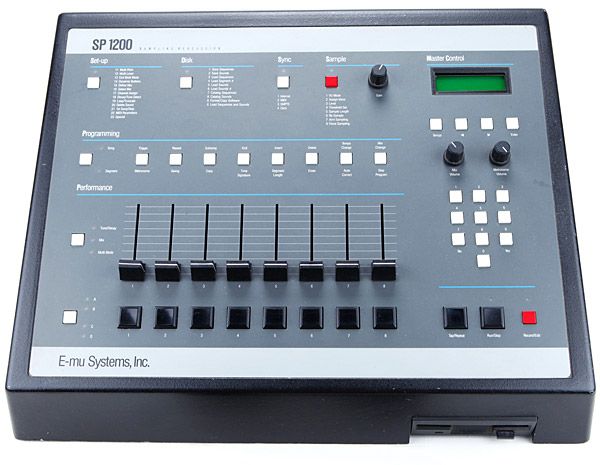
The E-mu SP-1200 is a 12-bit drum machine and sampler released in 1987, and it is responsible for the sonic texture of a significant portion of hip-hop's golden era. Its combination of low sample rate (26,040 Hz), 12-bit quantisation, and the SSM2044 filter chip created a sound that producers could have worked around — and instead built a genre around.
The Sound of the Machine
The SP-1200 samples at 26,040 Hz — a deliberately lowered rate chosen to fit 10 seconds of audio into 384 KB of memory. At that rate, high frequencies alias, folding back into the audible spectrum as artefacts. The SSM2044 filter chips shape those artefacts differently across the eight outputs: outputs 1 and 2 run through envelope-controlled low-pass filters (ideal for kicks and toms), outputs 3–6 through static low-pass filters, and outputs 7 and 8 are completely unfiltered. Combined with 12-bit quantisation, the result is a sound with grain, tightness in the low end, and a midrange saturation that cleaner samplers could not replicate.
Production ended around 1997 not because Roland chose to stop, but because E-mu ran out of SSM2044 chips. A Final Edition in an all-black case was the last run. The machine that launched at $2,995 in 1987 now sells for multiples of that.
Records Built on the SP-1200
Pete Rock & CL Smooth's "They Reminisce Over You" (1992) was produced on the SP-1200 at Greene Street Studios. DJ Premier used it through Gang Starr's Step in the Arena (1991) and Daily Operation (1992) — he has called it "the weapon of choice." The Bomb Squad used it on Public Enemy productions including "Fight the Power" (1989). Easy Mo Bee produced more than a third of The Notorious B.I.G.'s Ready to Die on the SP-1200, including playing bass lines live through it. A Tribe Called Quest used it on People's Instinctive Travels (1990).
How Producers Extended Sample Time
Ten seconds of total memory across four banks of 2.5 seconds each was tight. Producers found a workaround: record source material sped up (playing a 33 rpm record at 45 rpm, for example), then pitch the sample back down inside the SP-1200. The pitch correction effectively doubled the usable sample time at the cost of some high-frequency content — which, given the machine's character, was often no loss at all.
Who Is This For?
The SP-1200 is collector and working-producer equipment. There is no software equivalent that fully captures its sound — the SSM2044 filter response and the interaction between the aliasing and the circuit path are what make it distinctive. Rossum Electro-Music (founded by E-mu co-founder Dave Rossum) released a faithful hardware reissue in 2021 for those who want the architecture without the vintage maintenance burden. Original working units in good condition sell for £2,500–£4,500 depending on condition.
Videos
Frequently Asked Questions
Specifications
| Released | 1987 |
| Sample resolution | 12-bit linear |
| Sample rate | 26,040 Hz |
| Total sample memory | ~10 seconds (384 KB across 4 banks of 2.5 seconds each) |
| Sample slots | 32 (4 banks of 8 pads) |
| Polyphony | 8 voices |
| Sequencer | Built-in with swing timing; SMPTE sync |
| Outputs | 8 individual (2 envelope-filtered, 4 static-filtered, 2 unfiltered) + mono mix |
| Filter chip | SSM2044 (envelope-controlled low-pass on outputs 1–2) |
| Storage | 3.5" double-sided double-density floppy disk |
| MIDI | In / Out |
| Launch price | $2,995 (1987) |
| Manufacturer | E-mu Systems |
Looking to Buy Used?
Browse current listings on Reverb and eBay to find deals.
Related Gear
Specs and prices are for reference only and may be outdated or contain errors. See full disclaimer. Affiliate links may earn commission.