Electro-Harmonix Big Muff Pi
Electro-Harmonix Big Muff Pi
Avg. used price: ~£42(based on recent Reverb sales)·What are these selling for? →

GearBook helps you research music gear prices. Compare sold prices across Reverb and eBay, see market trends, and find the best deals.
Try a price search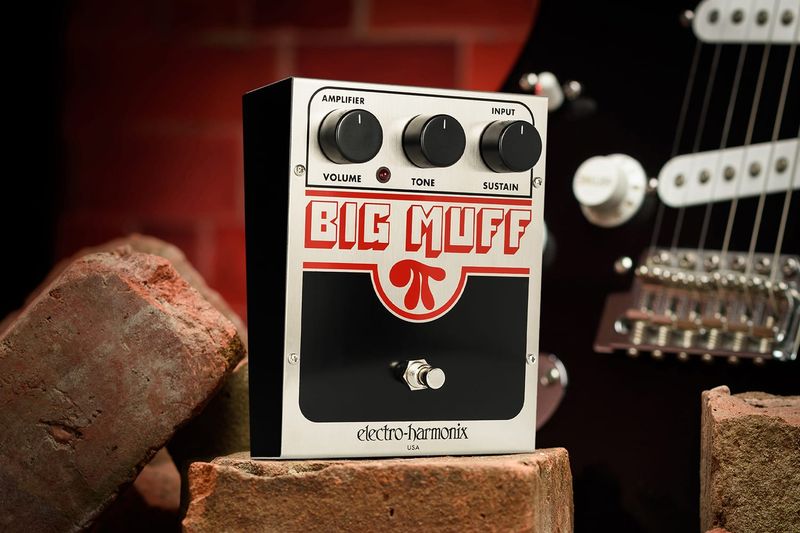
Few pedals have shaped the sound of rock guitar as fundamentally as the Electro-Harmonix Big Muff Pi. Introduced in 1969, it was designed from the outset for thick, sustained distortion — not the mild break-up of earlier overdrive pedals, but a full, saturating fuzz with a singing, violin-like quality that could hold a note seemingly indefinitely. Over five decades it has appeared on some of the most recognisable guitar recordings ever made, and it remains in continuous production today.
The defining characteristic of the Big Muff is its mid-scoop. Where most distortion pedals retain midrange presence, the Big Muff's circuit naturally dips the mids and pushes the bass and treble, producing a thick, pillowy fuzz that sounds enormous on its own. This character is both its greatest strength and its main limitation — it sits back in a dense mix without boosting mids downstream, but for leads, drones, and wall-of-sound rhythm parts it's unmatched.
The three controls are straightforward. Sustain sets the gain and compression — high settings produce maximum saturation and sustain with notes bleeding into each other; lower settings retain more pick attack and dynamics. Tone sweeps from dark and woolly on the left to thin and bright on the right, with the usable sweet spot typically found in the centre. Volume sets the output level.
The list of artists who built defining sounds on the Big Muff reads like a history of rock: David Gilmour used a Ram's Head version for the sustained leads on Animals and The Wall. Billy Corgan stacked an Op-Amp Big Muff into a saturated Marshall to create the guitar sound on Siamese Dream. J Mascis made the Sovtek-era version synonymous with American indie rock across Dinosaur Jr's early albums. Kurt Cobain, Jack White, and Mudhoney — who named their debut EP Superfuzz Bigmuff — all built careers around variations of the same circuit.
The current NYC Reissue uses the same fundamental design that has been in production since 2000. It runs on a 9V battery or standard centre-negative adapter, uses true bypass switching, and retains the classic large enclosure with the triangular knob layout. The Nano Big Muff uses the same circuit in a smaller pedalboard-friendly housing with true bypass — the tonal difference is minor, though the standard version is generally considered slightly fuller and bassier.
Who Is This For?
The Big Muff Pi is the first choice for guitarists chasing psychedelic sustain, grunge distortion, shoegaze wall-of-sound, or classic fuzz tones. It's equally effective on bass — the circuit's natural bass emphasis translates well to low-end saturation. At its price point on the used market it's one of the best value pedals available. If you want a more mid-forward fuzz with greater note definition, look at the Fuzz Face or a RAT. If you want the big, sustained, scooped fuzz sound that defined half a century of rock guitar, there's nothing else quite like the Big Muff Pi.
Videos
Frequently Asked Questions
Specifications
| Circuit | Analog |
| Bypass | True bypass |
| Controls | Volume, Tone, Sustain |
| Audio | Mono |
| Power | 9V battery (included) or 9.6VDC-100mA adapter |
| Current Draw | 3mA |
| Dimensions | 5.5 × 2.95 × 6.88" |
| Year Released | 2000 (NYC Reissue) |
Resources
Buy New
Buy from authorized retailers. Affiliate links may earn commission.
Looking to Buy Used?
Browse current listings on Reverb and eBay to find deals.
Related Gear
More from Electro-Harmonix

Specs and prices are for reference only and may be outdated or contain errors. See full disclaimer. Affiliate links may earn commission.