Boss DS-1
Boss DS-1
Avg. used price: ~£36(based on recent Reverb sales)·What are these selling for? →

GearBook helps you research music gear prices. Compare sold prices across Reverb and eBay, see market trends, and find the best deals.
Try a price search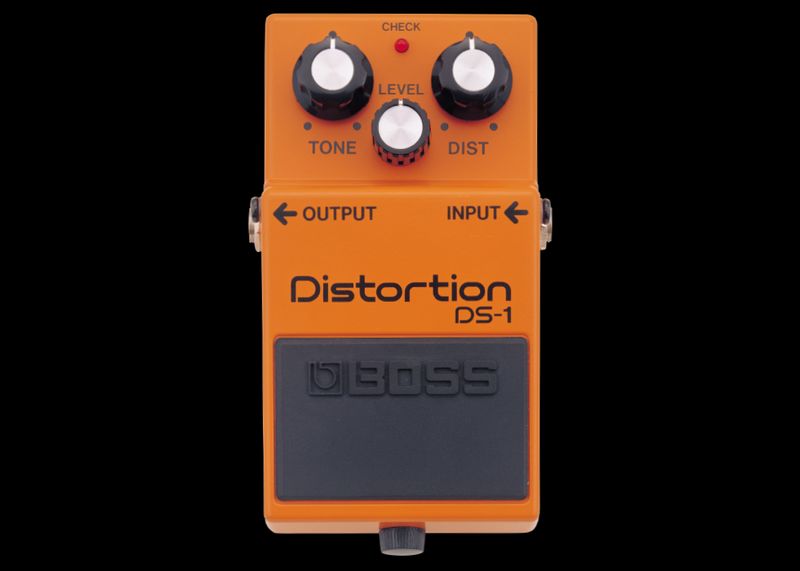
The Boss DS-1 Distortion is the best-selling Boss compact pedal ever made, and one of the most widely used effects pedals in history. Introduced in 1978 as Boss's first distortion pedal, it delivered something genuinely new: tight, hard-edged gain with rich harmonics that stayed clear and defined even at high distortion settings — where most pedals of the era became muddy and indistinct. That original circuit, largely unchanged in over 45 years of continuous production, remains on pedalboards from bedroom studios to world stages.
The DS-1's circuit uses a two-stage design combining transistor and op-amp gain stages. This combination is the source of its characteristic low-frequency fullness — the bottom end stays present and controlled rather than getting thin as the gain increases, which is why it works particularly well for heavy rhythm playing. The Dist knob covers an exceptionally wide range: at low settings it functions as a clean boost capable of driving an amp or stacking into another pedal; at maximum it delivers full-on hard rock saturation.
The tone control is more useful than it first appears. Unlike simple treble-cut circuits, the DS-1's tone shaping simultaneously adjusts highs and lows in opposite directions — clockwise increases treble and reduces bass, counter-clockwise adds bass and rolls off the top. This means you can dial in tight, cutting rhythm tones or smooth, fat lead voices from the same pedal without the low-end bloat that affects simpler designs.
The DS-1 responds well to guitar volume — rolling back the guitar's volume control cleans up the tone noticeably without introducing muddiness, which extends its usable range beyond what the three knobs suggest. It also stacks well with other drives and responds to different pickups and guitars in ways that preserve their individual character rather than homogenising everything into the same distortion.
Kurt Cobain used the DS-1 extensively — it features on Nirvana's recordings including Nevermind and was a core part of his live rig. Joe Satriani, Steve Vai, and Stevie Ray Vaughan have all used the DS-1 at various points. Its combination of affordability, reliability, and genuine tonal character has made it the default reference point against which other distortion pedals are measured.
Who Is This For?
The Boss DS-1 suits guitarists across rock, punk, grunge, and hard rock who want a proven, reliable distortion at minimal cost. It's the natural starting point for anyone building a first pedalboard, and it remains a working tool for professionals who value its specific character over more expensive alternatives. On the used market it's one of the best value pedals available — widely available, easy to find in good condition, and cheap enough that buying one is low risk. If you want something more transparent and amp-like, look at the SD-1 or BD-2. If you want the classic hard-edged distortion that defined decades of rock guitar, the DS-1 is the standard.
Videos
Frequently Asked Questions
Specifications
| Circuit | Analog (transistor + op-amp stages) |
| Controls | Dist, Tone, Level |
| Bypass | Buffered bypass |
| Input Impedance | 1 MΩ |
| Output Impedance | 1 kΩ |
| Power | 9V battery or PSA adapter (sold separately) |
| Current Draw | 10mA |
| Battery Life | Approx. 80 hours (alkaline) |
| Dimensions | 73 × 129 × 59mm |
| Weight | 360g |
| Year Introduced | 1978 |
Resources
Buy New
Buy from authorized retailers. Affiliate links may earn commission.
Looking to Buy Used?
Browse current listings on Reverb and eBay to find deals.
Related Gear
More from Boss
Specs and prices are for reference only and may be outdated or contain errors. See full disclaimer. Affiliate links may earn commission.