Chase Bliss MOOD MkII
Chase Bliss MOOD MkII
Avg. used price: ~£336(based on recent Reverb sales)

GearBook helps you research music gear prices. Compare sold prices across Reverb and eBay, see market trends, and find the best deals.
Try a price search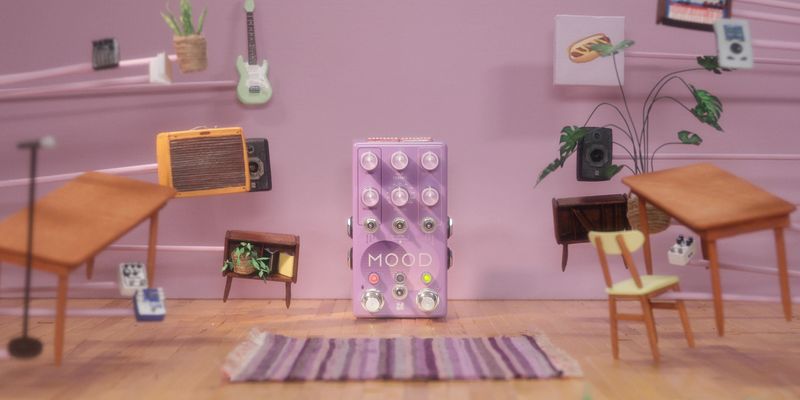
The Chase Bliss Audio MOOD MkII is a dual-channel micro-looper and ambient effects pedal, the product of a three-way collaboration: Chase Bliss Audio's architecture, Drolo FX designing the looper channel, and Old Blood Noise Endeavors designing the effects channel. The key idea is that the two channels are aware of each other — they share a Clock control and can be routed so that one feeds the other, creating feedback loops that evolve and change over time.
Channel 1 — Micro-Looper (Drolo FX)
The looper is always listening. When you engage it, it commits the last captured moment to a short loop. Three modes shape what happens next: Env slices the loop into stutters and freeze effects; Tape adjusts speed and direction including reverse; Stretch time-stretches into smeared, granular textures. The MkII adds overdubbing, a freeze function that holds the loop as an infinite pad, and doubled loop length compared to the original.
Channel 2 — Wet/Spatial FX (Old Blood Noise Endeavors)
Three modes cover different sonic territory: Reverb runs from lush atmospherics to comb-filtered resonance; Delay covers simple repeats through to pitch-shifted echoes; Slip manipulates time — moving forwards or backwards through material, half-speed, double-speed. The MkII adds full stereo and a freeze function that holds the effects output as an ambient pad or secondary loop.
The Clock and Channel Interaction
The Clock knob governs both channels simultaneously. Turn it and the sample rate shifts across both sides in calibrated steps, moving pitch and timing together rather than in isolation. Routing between channels is flexible — the wet channel can process the looper's output, the looper can record the wet channel's output, or they run in parallel. This creates the conditions for self-feeding, generative soundscapes that develop without intervention.
MkII Improvements
The original MOOD had a cult following among ambient musicians. The MkII keeps that character while adding full stereo, unlimited overdubbing, doubled loop length, 122 MIDI presets, full expression and CV control, switchable true or buffered bypass, and eliminated the clock noise present in the MkI. A Classic Mode restores the MkI character for those who want it.
Who Is This For?
The MOOD MkII suits ambient guitarists, synthesiser players, and sound designers who want a hardware tool for generating evolving textures and drone pads from any input. It rewards slow exploration — the 16 dip switches, hidden secondary controls, and deep MIDI implementation make it a long-term instrument rather than a set-and-forget effect. It is not a conventional looper for building live arrangements, and it is not simple. Players who find that appealing will find the MOOD MkII endlessly productive.
Videos
Frequently Asked Questions
Specifications
| Channel 1 | Micro-looper (Drolo FX) — Env, Tape, Stretch modes; overdub, freeze, doubled loop length |
| Channel 2 | Ambient FX (Old Blood Noise Endeavors) — Reverb, Delay, Slip modes; stereo, freeze |
| Signal path | Full stereo (TRS or dual TS) |
| Analog dry through | Yes |
| Bypass | Switchable true bypass or buffered bypass |
| Presets | 2 onboard; 122 via MIDI |
| MIDI | ¼" TRS — note, CC, program change, clock sync; MIDIBox adapter for 5-pin DIN |
| Expression/CV | TRS expression jack or 0–5V CV via floating-ring TS |
| Dip switches | 16 external for deep parameter control |
| Internal modulation | Any knob can be set to ramp/modulate |
| Firmware | Micro USB updates |
| Power | 9V DC centre negative, ~270mA (no battery) |
| Dimensions | 74 × 124 × 60 mm (including protrusions) |
Resources
Looking to Buy Used?
Browse current listings on Reverb and eBay to find deals.
Related Gear
Specs and prices are for reference only and may be outdated or contain errors. See full disclaimer. Affiliate links may earn commission.