u-he Satin

GearBook helps you research music gear prices. Compare sold prices across Reverb and eBay, see market trends, and find the best deals.
Try a price search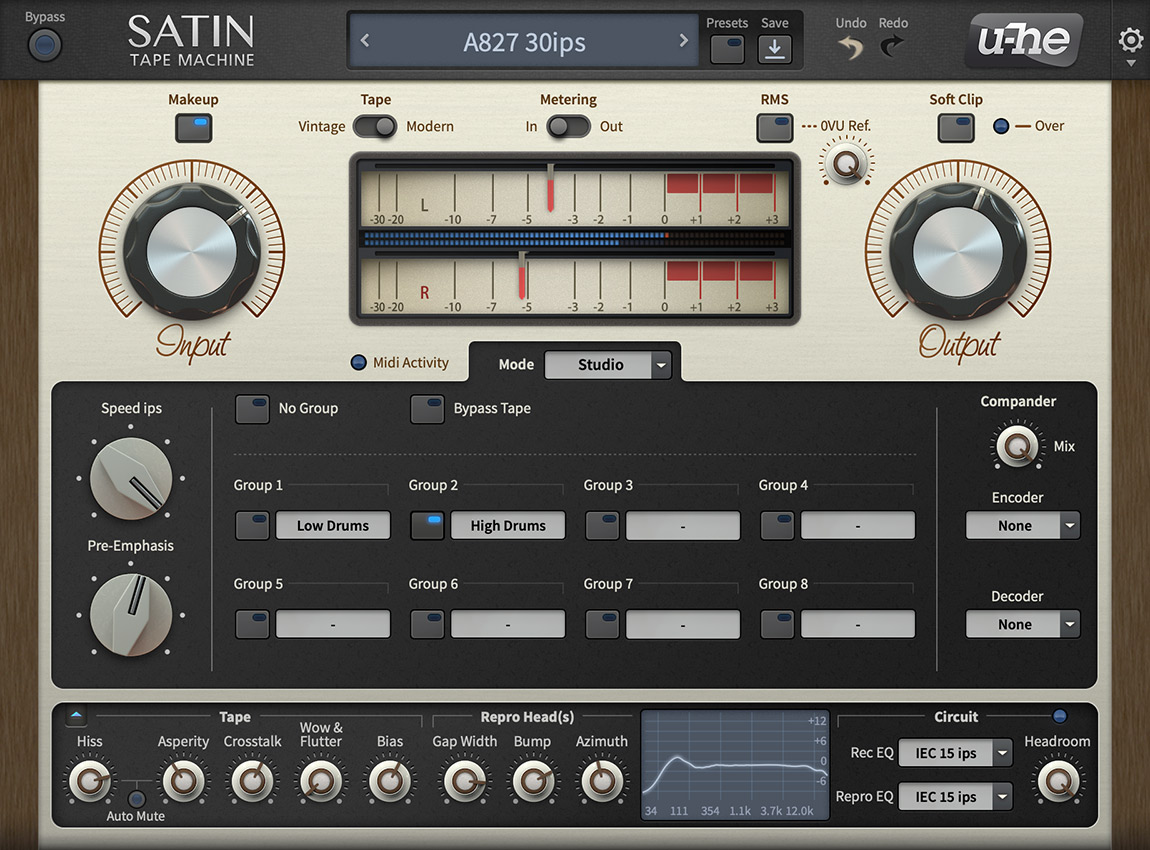
Tape saturation plugins come in two varieties: fixed emulations of specific machines, and toolkits. Satin is firmly the latter. Rather than replicating a single tape recorder, u-he modelled the individual components — heads, circuits, noise reduction systems, EQ curves — and assembled them into something you configure yourself. The result covers everything from subtle mix bus warmth to deliberately degraded cassette textures, depending on how you set it.
At its most restrained, Satin adds the kind of gentle compression, transient smoothing, and harmonic saturation that mix engineers associate with running stems through a well-maintained tape machine. A modest saturation setting, fast tape speed (15 or 30 ips), and a quiet Service Panel is all it takes — adding presence and cohesion without anything you could point to and call an effect.
The Service Panel is where Satin separates from simpler tape emulations. Hiss, asperity noise, wow and flutter, crosstalk, and bias are all independently adjustable. The tape head parameters — gap width and azimuth — let you cut or boost specific frequencies and introduce spatial effects by simulating physical head misalignment. Together these controls cover everything from a pristine studio machine to a decades-old cassette that spent too long in someone's attic.
Five noise reduction models are included: A-Type (modelled on Dolby A professional), A-Type Mod (a treble-only variant), B-Type (modelled on Dolby B consumer), uhx Type I and uhx Type II (modelled on dbx Type I and II respectively). These work in both directions — encoding for a noise-reduction effect, or decoding for correcting recordings that were made with NR processing and never properly decoded.
Five independent EQ curves cover the major tape standards: Flat, IEC at 7.5 and 15 ips, NAB, and AES at 30 ips. Because recording and reproduction EQ can be selected independently, mismatching them opens up corrective uses for old recordings or deliberate tonal shaping.
Beyond saturation, Satin includes full tape delay and flanging modes. The delay section offers two or four playback heads with multiple-mono, cross, and ping-pong routing; tape speed is continuously variable from 1.875 to 30 ips, giving delay times ranging from long ambient echoes to tight slapback. The flange mode supports classic through-zero flanging. When running multiple instances, the Group panel lets you control up to eight simultaneously from a single interface.
Who Is This For?
Producers and engineers who want a tape emulation they can tune precisely — from transparent bus glue to deliberate degradation. Satin's toolkit approach and the depth of the Service Panel make it more versatile than machine-specific emulations, and the Group panel makes it practical at scale.
Videos
Frequently Asked Questions
Specifications
| Tape Speed | 1.875–30 ips (continuously variable) |
| NR Models | A-Type, A-Type Mod, B-Type, uhx Type I, uhx Type II |
| Circuit EQs | Flat, IEC 7.5 ips, IEC 15 ips, NAB, AES 30 ips (rec/repro independently selectable) |
| Delay Heads | 2 or 4 — multiple-mono, cross, ping-pong routing |
| Flange Mode | Yes — classic through-zero flanging |
| Group Control | Up to 8 instances per group |
| Internal Sample Rate | Up to 384 kHz |
| Formats | CLAP, VST3, AUv2, AAX |
| Platform | macOS 10.10+, Windows 7+, Linux (Apple Silicon native) |
| Licence | Perpetual — serial number, no iLok, unlimited personal machines |
| Demo | Free demo available (full functionality, periodic noise) |
Resources
Buy New

Buy from authorized retailers. Affiliate links may earn commission.
Related Gear
Specs and prices are for reference only and may be outdated or contain errors. See full disclaimer. Affiliate links may earn commission.