Behringer Poly D
Behringer Poly D
Avg. used price: ~£399(based on recent Reverb sales)

GearBook helps you research music gear prices. Compare sold prices across Reverb and eBay, see market trends, and find the best deals.
Try a price search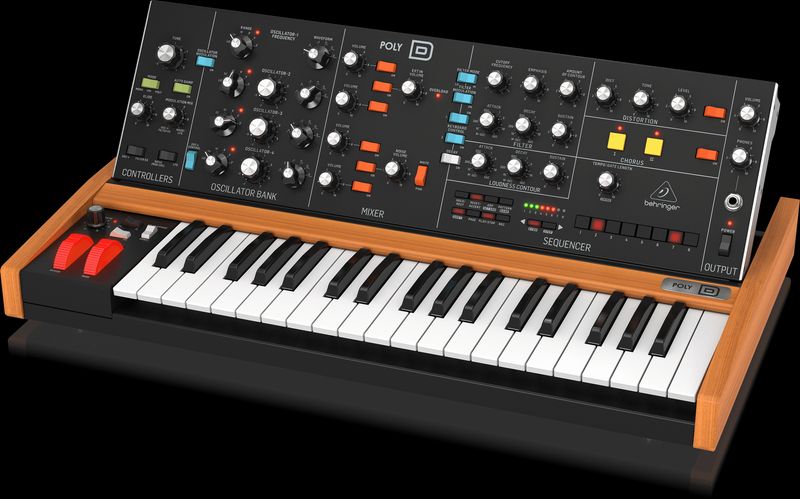
The Behringer Poly D takes the architecture of the Minimoog Model D — three oscillators, a 24 dB ladder filter, two envelopes — and multiplies it across four voices. The result is a paraphonic synthesizer: each voice has its own oscillators, but all four share a single filter and VCA. That distinction matters. Play a chord and the voices blend through one filter opening, giving pads and stabs a characteristic warmth and smear that's quite unlike a fully polyphonic instrument. Play it in mono or unison and it behaves exactly like a Minimoog.
Who Is This For?
The Poly D is aimed squarely at players who want real analog polyphony without the price of a Moog Subsequent 37 or a vintage Prophet. At its street price it's one of the most affordable ways to get Moog-style ladder filter tone in a keyboard with more than one note. It suits producers who want thick bass lines and leads, plus the ability to comp chords — and who understand that a paraphonic instrument sounds different from a true poly.
The 84 controls and knob-per-function layout make it immediate to use live. There's no menu diving, and every parameter is visible at a glance. Modular users will appreciate the extensive CV/gate section: pitch, velocity, after-pressure, and modulation outputs let you integrate the Poly D into a larger patch, and the external audio input lets you run signals through the ladder filter.
Built-In Effects
Two onboard effects deserve mention. The BBD stereo chorus is modelled on the Roland Juno-60's circuit — the same three-position switch (Speed 1, Speed 2, or both), the same warm, wide shimmer. It's the standout feature for pad sounds. The analog distortion, inspired by the Boss DS-1, adds gain and bite for leads. Neither effect is an afterthought.
Sequencer and Arpeggiator
A 32-step sequencer with eight pattern slots and real-time transposition is built in, along with an arpeggiator with eight playback modes. For live performance or sketch-pad use, these add significant utility over a bare keyboard.
New vs Used
New Poly Ds are readily available and competitively priced, which keeps the used market relatively flat. Second-hand units typically sell for £300–£420 in the UK and $350–$500 in the US. The build quality is solid — walnut-style cheekboards, metal panel, full-size keys — so a used example in good condition is a reliable buy. Check the chorus works correctly and that all CV jacks are functioning if connectivity matters to you.
Videos
Frequently Asked Questions
Specifications
| Voices | 4-voice paraphonic |
| Oscillators | 3 × VCO per voice (triangle, sawtooth, square, wide pulse, narrow pulse) + VCO 4 as modulation/LFO source |
| Filter | 24 dB/oct Moog ladder VCF, switchable low-pass / high-pass |
| Envelopes | 2 × ADS (filter and amp); release on/off switch |
| Keyboard | 37 full-size velocity-sensitive keys |
| Keyboard modes | Mono, Unison, Poly |
| Effects | BBD stereo chorus (Juno-60 inspired), analog distortion (DS-1 inspired) |
| Sequencer | 32-step, 8 pattern slots, real-time transposition |
| Arpeggiator | 8 playback patterns |
| MIDI | In / Out / Thru (5-pin DIN), USB-B |
| Audio I/O | 2 × balanced ¼" TRS stereo out, ¼" headphone out, ¼" external audio in |
| CV/Gate | Pitch, velocity, after-pressure, modulation CV outs; V-trig I/O; sync I/O |
| Power | 12V DC external |
| Weight | 5 kg |
Resources
Buy New
Buy from authorized retailers. Affiliate links may earn commission.
Looking to Buy Used?
Browse current listings on Reverb and eBay to find deals.
Related Gear
More from Behringer
Specs and prices are for reference only and may be outdated or contain errors. See full disclaimer. Affiliate links may earn commission.