Fairlight CMI
Fairlight CMI

GearBook helps you research music gear prices. Compare sold prices across Reverb and eBay, see market trends, and find the best deals.
Try a price search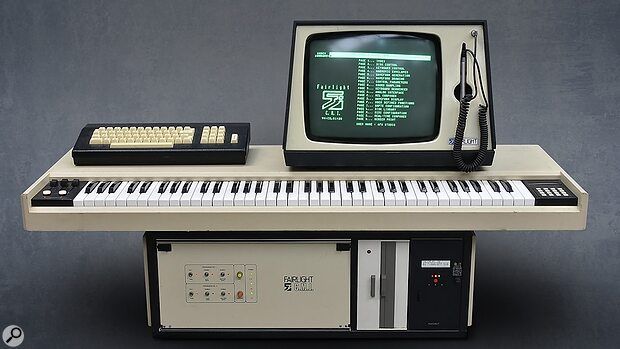
The Fairlight CMI (Computer Musical Instrument) is an Australian digital sampling workstation developed by Kim Ryrie and Peter Vogel in Sydney, launching commercially in 1979. It is widely credited as the first commercially available digital sampler and the instrument that effectively invented the concept of sampling — capturing a real-world sound and playing it back pitched across a keyboard. At a time when synthesis meant oscillators and filters, the CMI opened up an entirely new palette.
Who Is This For?
The Fairlight CMI is a collectible instrument for serious vintage hardware enthusiasts and collectors. Working examples sell for tens of thousands of pounds and require technical knowledge to maintain. It is not a practical studio tool in the conventional sense — it is a piece of music history. That said, it shaped the sound of popular music throughout the 1980s and remains deeply influential. If you encounter one, understanding what you are looking at matters.
What Made It Revolutionary
The CMI combined sampling, synthesis, sequencing, and audio editing in a single system — effectively inventing the digital audio workstation category a decade before the term existed. Its light pen interface allowed musicians to literally draw waveforms on screen, something no instrument had offered before. The Series II introduced Page R, a graphical grid-based pattern sequencer that directly foreshadowed the piano roll interface found in every modern DAW. The ORCH5 preset — a sample of orchestral brass stabs — became one of the most recognisable sounds of the decade, used by Art of Noise, Tears For Fears, Frankie Goes to Hollywood, and countless others.
The Models
The Series I (1979) ran on two 8-bit Motorola 6800 processors with 8-voice polyphony and 8-bit sampling at around 24 kHz. The Series II (1982) added the Page R sequencer. The Series IIx (1983) added MIDI and SMPTE sync — the first CMI to do so. The Series III (1985) was a major leap: 16-bit audio, sample rates up to 100 kHz, 16 MB RAM, a 140 MB hard disk, and a 73-note keyboard with velocity and aftertouch. Original retail prices ranged from around £18,000 for a Series I to over £60,000 for a fully-equipped Series III.
Famous Users
Peter Gabriel was among the first owners, using it on his 1980 album. Kate Bush became one of its most prominent advocates. Stevie Wonder, Herbie Hancock, Trevor Horn, Hans Zimmer, Jean-Michel Jarre, David Bowie, and Queen all used the instrument. Brad Fiedel used his Series III on the Terminator 2 score.
Today
Peter Vogel, one of the original co-creators, continues to build modern recreations under the Peter Vogel Instruments name. The CMI-30AX is a faithful hardware recreation running the original CMI software with contemporary specifications including 3 GB sample RAM and a 500 GB hard drive.
Videos
Frequently Asked Questions
Specifications
| Type | Digital sampler / sequencer / workstation |
| First Released | 1979 |
| Polyphony | 8 voices (Series I/II/IIx), 16 voices (Series III) |
| Sample Resolution | 8-bit (Series I–IIx), 16-bit (Series III) |
| Max Sample Rate | ~24 kHz (Series I), up to 100 kHz (Series III) |
| MIDI | From Series IIx (1983) onwards |
| Sequencer | Page R graphical sequencer (from Series II) |
| Interface | Light pen + VDU monitor + QWERTY keyboard |
| Storage | 8-inch floppy disks (later 3.5"); 140 MB hard disk (Series III) |
| Original Price | £18,000 (Series I) to £60,000+ (Series III) |
| Current Market | Collectible — working examples £15,000–£50,000+ |
| Manufacturer | Fairlight Instruments, Sydney, Australia |
Resources
Looking to Buy Used?
Browse current listings on Reverb and eBay to find deals.
Related Gear
Specs and prices are for reference only and may be outdated or contain errors. See full disclaimer. Affiliate links may earn commission.