UAD Lexicon 224

GearBook helps you research music gear prices. Compare sold prices across Reverb and eBay, see market trends, and find the best deals.
Try a price search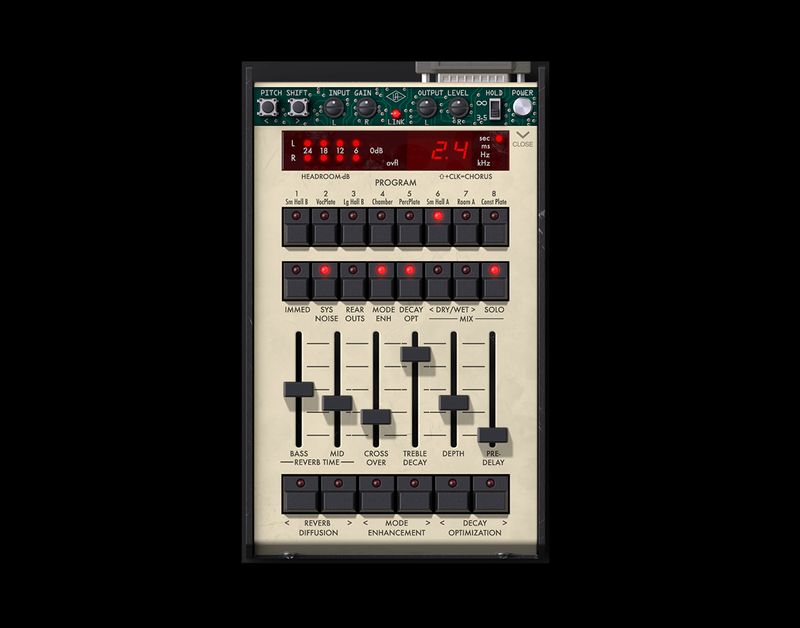
The UAD Lexicon 224 Digital Reverb is Universal Audio's meticulous emulation of one of the most iconic reverb units in recording history. The original Lexicon 224, introduced in 1979, defined the sound of digital reverb and was heard on countless hit records throughout the 1980s and beyond. UA has modeled every aspect of the hardware, including the input transformers, 12-bit AD/DA converters, control processor code, and the final version 4.4 firmware algorithms.
Nine Classic Algorithms
The plugin faithfully captures the Lexicon 224's nine era-defining reverb programs: two variations of Small Hall, Vocal Plate, Large Hall, Chamber, Percussion Plate, Room, Constant Density Plate, and a Chorus program. Each algorithm has its own distinct character. The Vocal Plate is silky and flattering on singers, the Percussion Plate adds snap and dimension to drums, the Large Hall delivers expansive cinematic spaces, and the Chamber program produces a versatile, natural-sounding ambience. These are the exact sounds that shaped the reverb vocabulary of popular music.
Controls and Sound Shaping
The interface mirrors the original hardware's parameter layout. The Crossover control sets the frequency point for the 224's distinctive split decay system, which allows Bass and Mid frequencies to decay at different rates. This is a defining characteristic of the Lexicon sound and lets you create reverbs where the low end dissipates quickly while the mids and highs linger, or vice versa. Depth adjusts the perceived distance between the source and the reverb, Predelay sets the gap before reverb onset, and Treble Decay controls how quickly high frequencies roll off in the tail. A Pitch Shift feature with 16 settings adds subtle modulation at lower values or more extreme detuning at higher settings.
Authentic Character
One of the most charming details is the switchable system noise that recreates the analog circuitry hiss and 12-bit converter character of the original unit. While you can turn it off for cleaner results, leaving it on adds an authentic vintage layer that contributes to the 224's unmistakable character. UA also added practical modern features including Dry/Wet mix and Solo Mix buttons for easy integration into any mixing workflow.
Who Is This For?
- Mix engineers who want the definitive Lexicon 224 sound for vocals, drums, and instruments
- Producers working in pop, rock, and R&B where the 224's reverb character is a genre staple
- Film and TV composers looking for lush, dimensional reverb spaces
- Vintage gear enthusiasts who want authentic 80s reverb without hunting for expensive, maintenance-heavy hardware
- UAD ecosystem users who want another world-class reverb in their plugin collection
The UAD Lexicon 224 is not just another reverb plugin. It is a faithful recreation of a specific piece of studio history that still sounds current decades later. If you have ever wanted that classic Lexicon shimmer and depth, this plugin delivers it with remarkable authenticity.
Videos
Frequently Asked Questions
Specifications
| Type | Digital Reverb Emulation Plugin |
| Modeled Hardware | Lexicon 224 (firmware v4.4) |
| Algorithms | 9 (Small Hall x2, Vocal Plate, Large Hall, Chamber, Percussion Plate, Room, Constant Density Plate, Chorus) |
| Key Controls | Crossover, Bass/Mid Decay, Depth, Predelay, Treble Decay |
| Special Features | Split decay, Pitch Shift (16 settings), Switchable system noise |
| Plugin Formats | VST3, AU, AAX, UAD-2 |
| Platform | macOS, Windows |
| Requires | UA hardware or UA Spark subscription |
Resources
Buy New

Buy from authorized retailers. Affiliate links may earn commission.
Related Gear
More from Universal Audio
Specs and prices are for reference only and may be outdated or contain errors. See full disclaimer. Affiliate links may earn commission.