Midicake ARP
Midicake ARP

GearBook helps you research music gear prices. Compare sold prices across Reverb and eBay, see market trends, and find the best deals.
Try a price search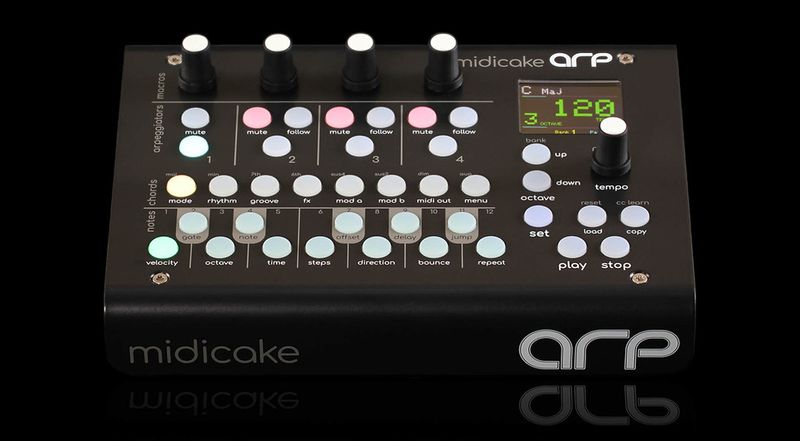
The Midicake ARP is a standalone hardware MIDI arpeggiator with four independent generator channels, each capable of running simultaneously in different modes. It generates no sound of its own — it sits between your controller and your synths, sending MIDI data to drive up to eight devices at once. The result is a hardware tool that can handle bass lines, chord patterns, melodies, and drones in parallel, without a DAW or computer involved.
Who Is This For?
The Midicake ARP suits hardware-centric producers who want complex, evolving patterns without relying on a sequencer or DAW. It works particularly well in desktop synth setups where you want multiple instruments playing complementary parts from a single chord input. Live performers who build sets around hardware find it useful for generating dynamic, repeatable patterns that respond to real-time chord changes. It has a steeper learning curve than a basic arpeggiator — it rewards time spent with it, but it is not a plug-and-play device.
Four Independent Channels
Each channel can operate in one of four modes: Arp, Chord, Pad, or Drone. They run simultaneously and each outputs on its own assignable MIDI channel, so you can drive four different instruments at once — or route multiple channels to the same instrument for layered patterns. Controls per channel include note direction, timing, step count, octave range, velocity, and delay, plus two dedicated modulators per channel with bar-synced LFO-style behaviour for evolving patterns over time.
Chord Engine
The ARP responds to chords played on a connected controller or programmed into its eight dedicated chord buttons. As of recent firmware, chord chaining allows up to 12-step chord progressions, and real-time chord inversions and voice leading give patterns musical coherence as they evolve. The developer's stated approach is that patterns are complex but deterministic — the same input produces the same output, which matters for live performance reliability.
Connectivity and Build
The unit is built in an aluminium enclosure with a small colour display and rubber buttons throughout. It has a single-octave keyboard for transposition and chord programming, four macro encoders, and full-size MIDI DIN in, out, and thru. A USB-A host port can power a bus-powered controller directly, useful for compact setups. It runs from USB power and works fully standalone without a computer.
Videos
Frequently Asked Questions
Specifications
| Generator Channels | 4 independent (Arp, Chord, Pad, Drone modes) |
| MIDI Outputs | Controls up to 8 devices simultaneously |
| Chord Buttons | 8 dedicated chord buttons |
| Keyboard | Single-octave (transposition + chord programming) |
| Encoders | 4 assignable macro encoders |
| Modulators | 2 per channel + 1 FX modulator (bar-synced LFO) |
| MIDI | MIDI In/Out/Thru (5-pin DIN) |
| USB | USB-B (MIDI + power), USB-A host port |
| Display | Small colour screen |
| Enclosure | Aluminium, black or white |
| Power | USB |
| Dimensions | 205 x 150 x 58 mm |
| Weight | 1.2 kg |
Resources
Looking to Buy Used?
Browse current listings on Reverb and eBay to find deals.
Related Gear
Specs and prices are for reference only and may be outdated or contain errors. See full disclaimer. Affiliate links may earn commission.