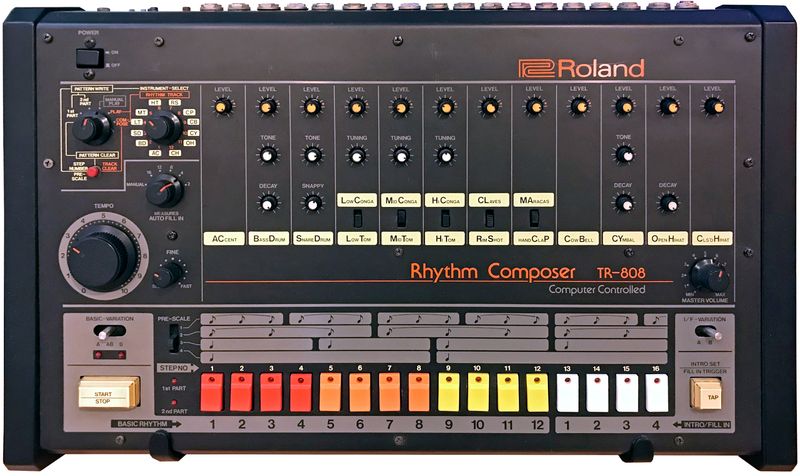
The Roland TR-808 was built with broken parts, rejected by the musicians it was designed for, and discontinued after three years. It then became the most influential drum machine in the history of popular music — appearing on more hit records than almost any instrument ever made. The story of how that happened begins with a batch of faulty transistors that nobody else wanted.
The Defective Parts
In the late 1970s, Roland founder Ikutaro Kakehashi was sourcing components for a new drum machine. Among the parts he acquired were 2SC828-R transistors — specifically a subset designated 2SC828-RNZ, identifiable by a small dab of paint on their casing. These were rejected components, parts that had failed standard quality control at manufacturers including Toshiba and Panasonic. Approximately 2–3% of transistors made to this specification produced a distinctive sizzling, noisy sound when passing current — a defect disqualifying them for normal use.
Kakehashi found them useful. By running batches of reject transistors through a testing process, Roland could identify and sort the usable subset. The resulting noise, filtered and shaped in different ways, became the raw material for the TR-808's snare drum, hi-hats, and handclap sounds — the distinctive sizzle of the 808 hi-hat and the metallic crack of its handclap come directly from transistors that should have been thrown away.
There is a persistent myth that the 808's famous bass drum also comes from defective components. It doesn't. The kick is an entirely separate circuit: a bridged-T bandpass filter triggered into self-oscillation by a voltage pulse, producing a decaying sine wave. When you tune the Decay knob and hear that deep, sustaining boom — that's analog oscillation, not transistor noise. The two halves of the 808's sound have entirely different origins.
Production came to an end not because Roland chose to stop, but because it became impossible to continue. As transistor manufacturing improved through the early 1980s, defect rates dropped. There were no longer enough faulty 2SC828-RNZ parts to source in sufficient quantity. After building approximately 12,000 units, Roland discontinued the TR-808 in 1983.
The Machine Nobody Wanted
The Roland TR-808~£4232 used was released in 1980 at a retail price of $1,195. It was designed as a practice and composition tool — a machine that would let solo musicians and songwriters rehearse or write without needing a live drummer. Lead engineer Tadao Kikumoto had proposed an analog synthesis approach rather than samples because PCM memory chips were still prohibitively expensive. Every sound on the 808 was built from scratch using circuits rather than recordings of real drums.
This was also its commercial problem. Musicians in 1980 wanted realism. The Linn LM-1, released the same year, used actual sampled acoustic drum sounds and cost $4,995. It sold to the studios and pop producers who could afford it. The TR-808, at a quarter of the price, sounded nothing like it. The bass drum was unnaturally deep and boomy. The snare was thin. The hi-hats had a papery sizzle. Nobody could mistake any of it for a real drum kit.
The machine sold poorly. By the mid-1980s, units were appearing in pawnshops and secondhand stores for as little as $100 — a price point that put it in the hands of exactly the musicians who would make it famous. Bedroom producers, hip-hop DJs, electro experimenters, and Chicago house producers who could never have afforded a Linn or a Yamaha RX.
One notable exception to the initial rejection: Kraftwerk had access to a prototype before the official launch and used it in their studio. Yellow Magic Orchestra performed with one at Tokyo's Budokan in 1980. And Japanese electronic musician Ryuichi Sakamoto used it on "Riot in Lagos" the same year — possibly one of the first recordings to feature the 808.
Sexual Healing and Planet Rock
The machine's commercial breakthrough came from an unexpected direction. In December 1981, Marvin Gaye arrived at Studio Katy outside Brussels with a Roland Jupiter-8 synthesiser and a TR-808 that he had pre-programmed himself. Engineer Mike Butcher recalled that when he first heard what became "Sexual Healing," it was just the 808 — Gaye had already laid out all the drum patterns before the session began. According to Butcher, Gaye was one of the first people to program the machine as its own instrument rather than an imitation of a real kit. He understood it on its own terms.
"Sexual Healing" reached number one on Billboard's Black Singles chart in November 1982 and stayed there for ten weeks. It was the first US hit single to feature the TR-808.
A few months earlier, Afrika Bambaataa had gone further. Working with producer Arthur Baker on "Planet Rock" for Tommy Boy Records, Bambaataa reportedly found his 808 programmer through a Village Voice classified ad: "Man with drum machine, 20 dollars a session." The operator was given Kraftwerk's "Numbers" as a template and programmed the beat accordingly. The result — fused with Kraftwerk and Yellow Magic Orchestra influences, a Fairlight synthesiser, and a vocoder — created a new genre in a single take. New York Times critic Robert Palmer called it "perhaps the most influential black pop record of 1982."
The 808's drum beat from "Planet Rock" has been sampled over 300 times.
The Science of the Kick
The TR-808's bass drum does something no acoustic drum can do: it produces a pure, sustaining tone in the sub-bass register. Here's why.
When the kick circuit is triggered, the bridged-T filter network begins oscillating at roughly 50–56 Hz — well into the range that physical speaker cones feel rather than reproduce cleanly. A feedback buffer sustains the oscillation for as long as the Decay knob allows — at maximum, the kick can ring for several seconds. A small pitch sweep at the front of the transient gives the characteristic click and fall. The result is a clean, almost harmonic-free sine wave.
This is fundamentally different from an acoustic kick drum, which produces a complex broadband sound with a decaying fundamental and multiple harmonics. The 808 kick has almost no upper harmonics — it's nearly a pure tone. On the small speakers and limited PA systems of 1980, this meant it sounded weak and unimpressive. On a modern sound system with subwoofers, it hits with physical force.
Producers quickly realised that extending the Decay and tuning the pitch turned the kick into a bass instrument. Sample that long, tuned kick note into a keyboard sampler, play it chromatically, and you have a melodic bassline with sub-bass weight that no synthesiser of the era could easily replicate. This technique became the foundation of Miami bass in the mid-1980s, Houston rap in the 1990s, and eventually the defining sonic signature of trap music.
808s & Heartbreak
By the late 1980s and through the 1990s, the 808 was embedded in hip-hop, R&B, and electronic music's DNA. But its most culturally significant second act came in 2008. Kanye West, dealing with the breakdown of his engagement and the death of his mother, made an album that placed the 808 at its emotional centre.
808s & Heartbreak opened with "Love Lockdown" — West's voice against a slowly tolling, pitched 808 bass pattern, nothing else. The album stripped away almost everything except the machine and Auto-Tuned vocals. It sold millions and divided opinion. More importantly, it introduced a generation of artists to the idea that the 808 could carry emotion as well as rhythm. Drake, The Weeknd, Kid Cudi, Frank Ocean, Juice WRLD, and Travis Scott all cite it as a formative influence.
Travis Scott has since become perhaps the most sophisticated mainstream user of the 808 as a melodic instrument — using pitch automation and glide to create sliding, expressive sub-bass patterns that function as full harmonic voices. On "SICKO MODE" (2018), the three beat changes each deploy different 808 approaches, treating the machine as the compositional centrepiece rather than the rhythmic backdrop.
The Legacy
An original TR-808 in working condition now sells for $3,500–$4,000 on the used market. Pristine examples have been listed at $14,000 and above, though dealers advise this is well above the functional going rate. The machine that pawnshops couldn't give away in 1984 is now a collector's instrument — though its sounds are simultaneously more accessible than they've ever been.
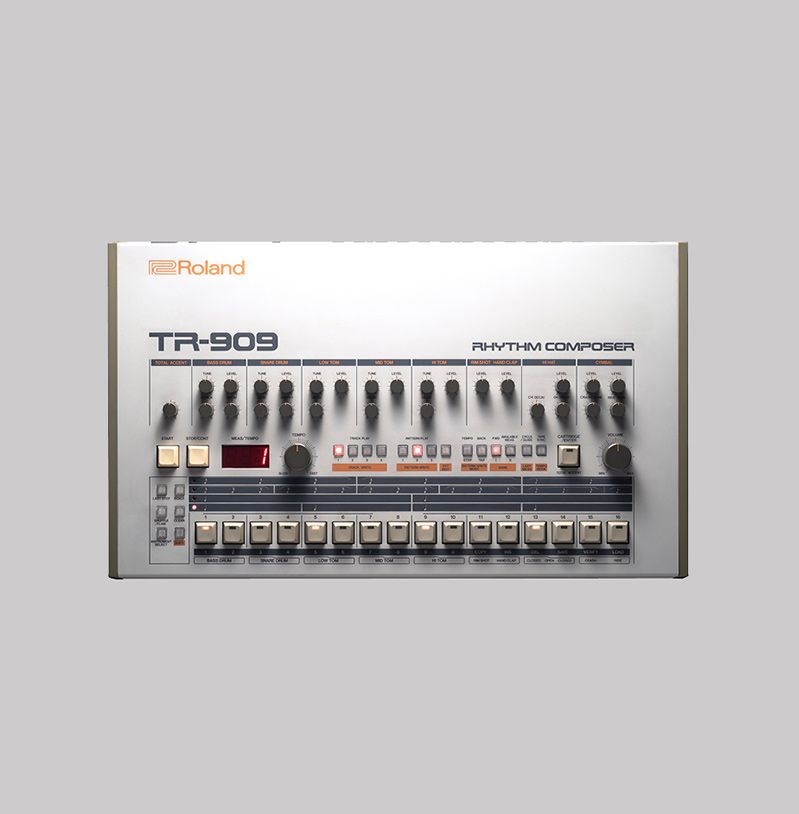
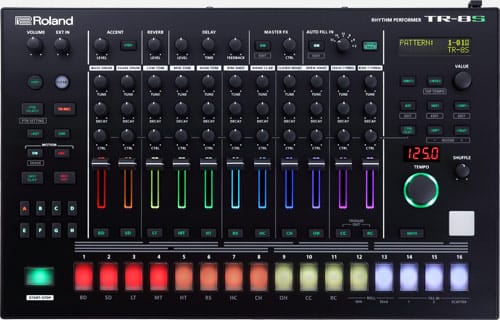
Roland has never reissued the original TR-808 hardware. The Roland TR-8S~£454 used offers ACB-based emulation of both the Roland TR-808~£4232 used and Roland TR-909~£4176 used, as does Roland Cloud's official software plugin. Hardware clones, software emulations, and sample packs have made the 808's sounds ubiquitous in every DAW. Most trap producers today have never touched a real unit — they're triggering samples.
The faulty transistors that Kakehashi salvaged from reject piles in the late 1970s appear, in some form, in virtually every genre of popular music made since 1982. R&B, hip-hop, house, techno, electro, Miami bass, trap, grime, drill, and countless subgenres all run on the machine that nobody wanted.
On 8 August each year — 8/08 — producers and musicians mark what has become known as 808 Day. It's an unofficial celebration of a drum machine that was discontinued as a failure, and went on to define the sound of half a century of popular music.