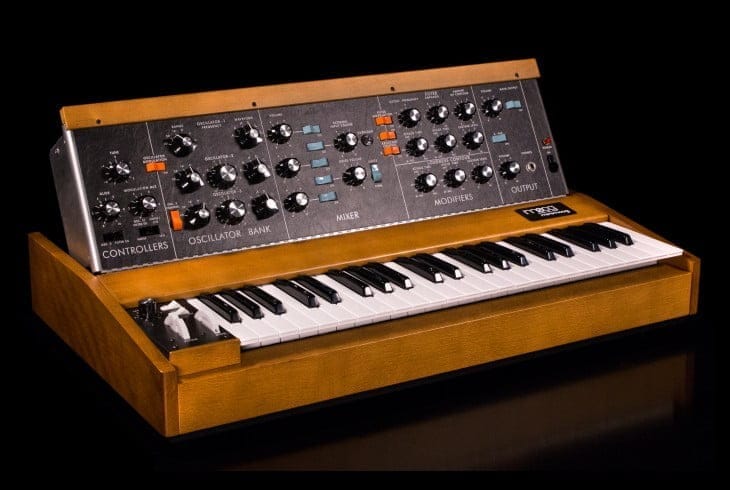
The first production Moog Minimoog Model D~£3413 used shipped on November 19, 1970. Bob Moog expected to sell maybe 100 of them. Over the next eleven years, roughly 12,000 units were made — and the instrument changed the course of popular music in ways Moog himself probably didn't anticipate when he initially tried to stop his engineers from building it.
The Problem With Early Synthesizers
Before 1970, synthesis was largely inaccessible to working musicians. The RCA Mark II synthesizer, built in 1957 at Columbia-Princeton, occupied an entire room. The custom Moog modular systems that followed in the mid-1960s were smaller but still enormous — multi-cabinet rigs that cost between $2,000 and $9,400 depending on configuration, at a time when the average annual wage was around $7,500. They were sold primarily to universities, research institutions, and a handful of wealthy rock musicians.
The practical limitations went beyond cost. A modular synthesizer generated sound by routing signals between individual modules using patch cables — a rat's nest of cables that had to be reconfigured from scratch to change patches. The instruments were famously unstable in tune. There was no standardised keyboard, no pitch bend, no way to set something up and expect it to work the same way twice. Performing live with a Moog modular meant either enormous technical support or accepting that the instrument would behave unpredictably.
Wendy Carlos's Switched-On Bach (1968) brought the Moog to mainstream attention, but it took Carlos and collaborator Benjamin Folkman months to assemble, and each note had to be recorded one at a time. The Beatles, Rolling Stones, and Monkees all acquired Moog modulars around this period. They remain largely curiosities in those bands' histories — instruments purchased but never properly integrated into their music, because integration was genuinely difficult.
The Minimoog Was Built Without Bob Moog's Permission
The Minimoog's origin is not a story of visionary design from the top. In late 1969, R.A. Moog Inc. engineer Bill Hemsath built an informal prototype by sawing a keyboard in half and wiring several surplus modular components into a small cabinet. When he presented it to Moog in November 1969, Moog was unimpressed and unenthusiastic.
Hemsath pressed on anyway, working with engineers Jim Scott and Chad Hunt to develop successive prototypes while Moog was away from the company. When Moog returned and found what they'd built, he chastised them. He then came around, authorised production, and the Model D — the fourth prototype iteration — became the production instrument.
The first unit shipped to sound engineer and dealer Walter Sear. Art Phelps designed the wooden case with its carry handle, deliberately sized to fit in an overhead locker. The pitch bend and modulation wheels — now the universal template for every synthesiser made since — were Hemsath's design, fabricated by machinist Don Pakkala.
It listed at $1,495 in 1971. A full Moog modular system cost $9,400. The Minimoog was roughly one-sixth the price, carried like a briefcase, and could be switched on and played.
What Made It Different
The Minimoog's central innovation was the fixed signal path. On a modular system, the routing of signal from oscillator to filter to amplifier had to be manually connected with patch cables every time. The Minimoog hard-wired that routing internally, with no patching required. A musician who had never touched a synthesiser could learn it in a day.
The instrument combined three voltage-controlled oscillators — allowing the rich, beating, detuned tones that became its signature — with Bob Moog's four-pole 24dB/octave lowpass filter. That filter is the instrument's defining characteristic: a particular harmonic quality, especially in resonance and self-oscillation, that has never been fully replicated. Decades of emulation, both hardware and software, have come close. Original units are still held to a standard none of them quite meets.
Part of the reason that standard is so hard to meet comes down to an accident. According to engineer Jim Scott — who worked directly on the Minimoog's circuits at R.A. Moog Inc. — the filter input was inadvertently overdriven by approximately 15dB above the intended signal level. By the time the miscalculation was discovered, the first production run had already begun. Moog left it in. The result was a filter with more harmonic content and more aggressive character than designed — the particular edge and warmth that defines the Minimoog sound is partly a consequence of a circuit running harder than it was supposed to.
The oscillators contributed their own happy accident. The Minimoog's power supply was noisy enough to prevent the three oscillators from phase-locking with each other. Scott described this as deliberately beneficial — just enough instability to keep the oscillators loose and independently drifting, which is the source of that characteristic organic movement in Minimoog patches. Engineers at competing manufacturers tried to solve this problem. The Minimoog left it alone.
The Minimoog was also the first synthesiser sold through regular music retail shops rather than custom-ordered direct from the manufacturer. It arrived, in other words, in the same places musicians bought everything else.
There is a parallel with early automotive history here that is worth making explicit. Before the 1920s, car controls varied wildly between manufacturers — pedal arrangements, steering configurations, gear positions all differed depending on who built the vehicle. One arrangement gradually proved itself, the industry converged on it, and within a generation it became so universal that drivers assumed it had always been the only logical way. Nobody now sits in a car and wonders why the pedals are arranged the way they are.
The Minimoog did the same thing for synthesisers, more quickly and more completely. The pitch bend wheel to the left of the keyboard, the modulation wheel beside it — those were Bill Hemsath's design, fabricated specifically for this instrument. No synthesiser before the Minimoog had them. Every major synthesiser manufacturer since has copied them. The layout is so embedded in how musicians interact with synthesis that it now feels inevitable, which is exactly what standardisation does: it makes one set of arbitrary choices feel like the only logical ones. The Minimoog's wheel layout was not inevitable. It became universal.
The Artists Who Defined Its Sound
Sun Ra was among the first to play any version of the instrument. In autumn 1969, Moog loaned Sun Ra a Model B prototype — before the production Model D existed. A session from that period was eventually released decades later as the "Moog Experiment" tracks on My Brother the Wind, Vol. 2 (Evidence Records, 1992). Sun Ra used it as an extension of his cosmic, dissonant approach; his recordings with it sound unlike almost anything else made with a Minimoog before or since.
Keith Emerson is often cited in connection with the Minimoog, and the synth solo on "Lucky Man" from the ELP debut (1970) is frequently attributed to it — but that solo is the Moog modular, not a Minimoog. The Model D barely existed when that album was recorded. Emerson subsequently moved to Minimoog for live touring and studio work; Trilogy (1972) documents his early use of the production instrument.
Rick Wakeman acquired his first Minimoog in 1971 and used it on Yes's Fragile that same year, and prominently on Close to the Edge (1972). Wakeman reportedly toured with up to six Minimoogs simultaneously — partly for reliability (a failed unit mid-show could be abandoned) and partly because the instrument was now affordable enough to own multiples.
The most consequential Minimoog bass line in popular music came from Bernie Worrell of Parliament. "Flash Light," from Funkentelechy vs. the Placebo Syndrome (1977), built its foundation from Minimoog synthesizers connected together. The New York Times later described Worrell's approach as "a descending and ascending chromatic line with a meaty tone and a certain swagger, an approach that would spread through funk, new wave, electro, synth-pop and countless other iterations." That description captures something real: the Minimoog bass had a physical weight and mobility that no keyboard had produced before, and it opened up bass as a melodic instrument in ways that shaped the next four decades of popular music.
The Model D Today
Original production ran from 1970 until July 1981, when Norlin Musical Instruments — the conglomerate that had acquired Moog Music in 1973 — ended the run. Around 12,000 units were made across three distinct eras, and collectors treat them differently.
The earliest units — serial numbers 1001 to roughly 1210, built at the original Trumansburg, NY factory under Bob Moog's direct oversight — carry the R.A. Moog nameplate and command a significant premium on the used market: $7,000–$8,000 for excellent examples, versus around $5,000 for a standard Moog Music Inc. unit in comparable condition. A brief transitional batch of roughly 150 units was labelled Moog muSonics after venture capitalist Bill Waytena bought a controlling stake in 1971 and relocated production to Williamsville near Buffalo — the rarest variant of all, with a single Soundgas listing recently at over $9,000. The Norlin acquisition followed in 1973; quality control became less consistent, and later units (from approximately serial 10,176 onwards) received revised oscillator boards with better tuning stability but a character that most collectors consider slightly less interesting than the earlier "old boards."
The RA Moog premium is partly scarcity, partly provenance — those first units were made by the people who invented the instrument, in the building where it was invented — and partly the sound of those Version 2 oscillator boards, which are considered the most sonically characterful of the production run.
Moog reissued the Model D in 2016 with MIDI, an independent LFO, and a velocity-sensitive keyboard. Production lasted about a year. In late 2022 a second reissue followed, priced at £5,299, with a spring-loaded pitch wheel and revised aesthetics. Demand exceeded supply and Moog ran out of components; that run ended too.
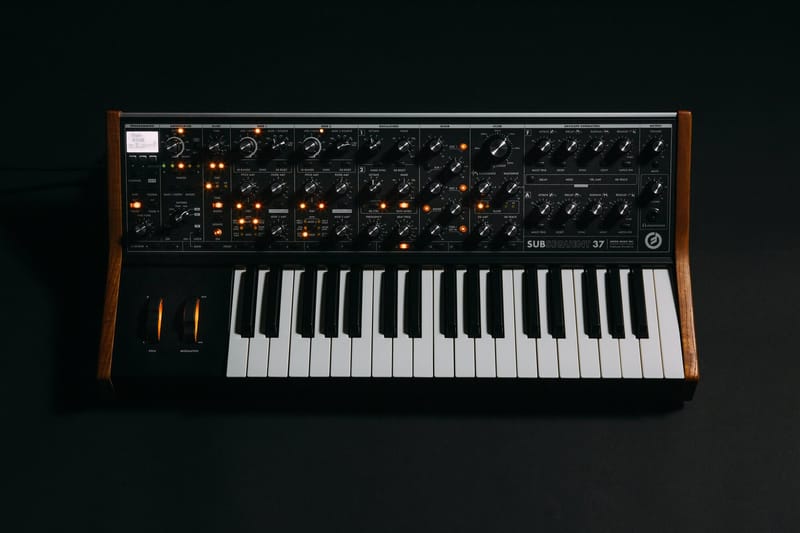
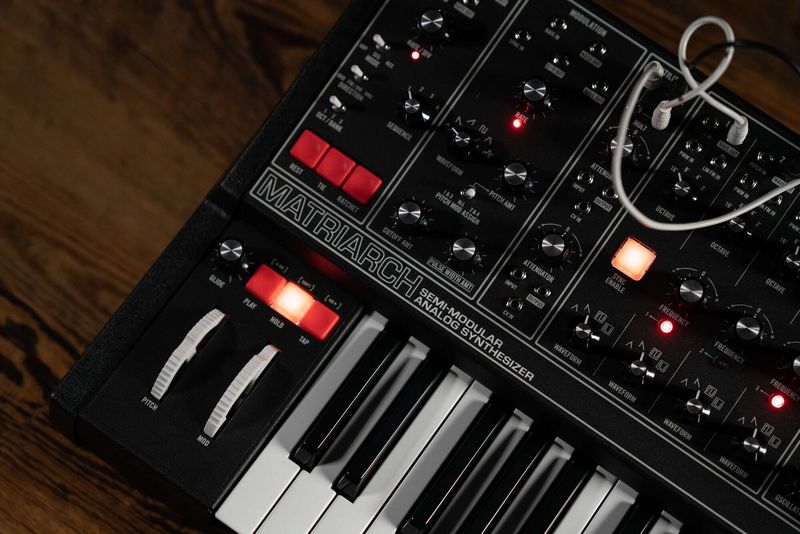
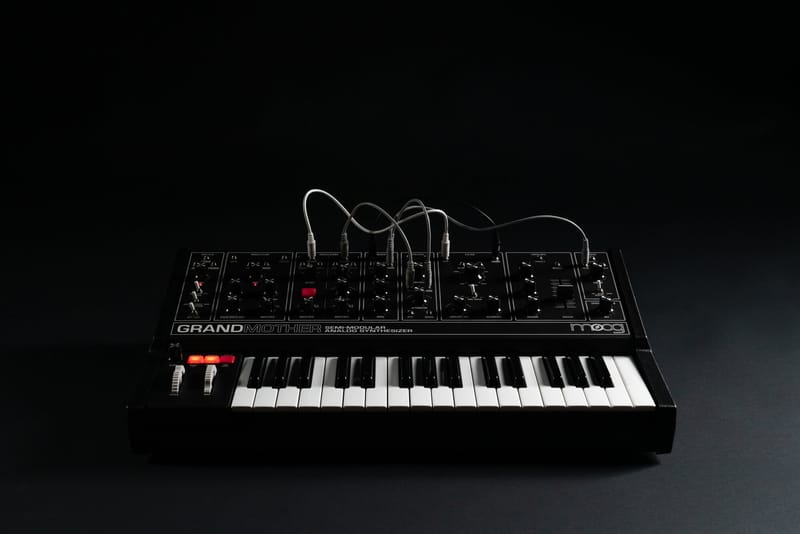
In June 2023, Moog Music was acquired by inMusic, the parent company of Akai and M-Audio. The company has continued operating under that umbrella. Moog's current synthesiser line — the Moog Grandmother~£605 used, Moog Matriarch~£1250 used, and Moog Subsequent 37~£1073 used among others — all descend in one way or another from the filter and oscillator designs that Hemsath's engineers stabilised in 1970.
Vintage Model D units sell for $4,000–$8,000 depending on condition, and have never sustained a significant decline in value. They are played, not just collected — which is probably the most accurate measure of what the instrument meant.
The Legacy
The Minimoog's specific contributions are easy to list: it made synthesis portable, affordable, and learnable. It defined the physical interface — pitch bend wheel, modulation wheel, keyboard — that every subsequent synthesiser copied. It introduced musicians to the Moog filter, whose particular character became the standard against which all synthesis was measured.
The harder thing to quantify is the cultural shift. Before the Minimoog, a synthesiser was a curiosity or a research tool. After it, synthesis was a musical instrument. Progressive rock, jazz-fusion, funk, Krautrock, synth-pop, hip-hop — each of these genres found something essential in the Minimoog or in instruments that descended from it. The prototype built in a corner of the factory while Bob Moog was away turned out to be one of the most consequential musical instruments ever made.