Roland Jupiter-8
Roland Jupiter-8

GearBook helps you research music gear prices. Compare sold prices across Reverb and eBay, see market trends, and find the best deals.
Try a price search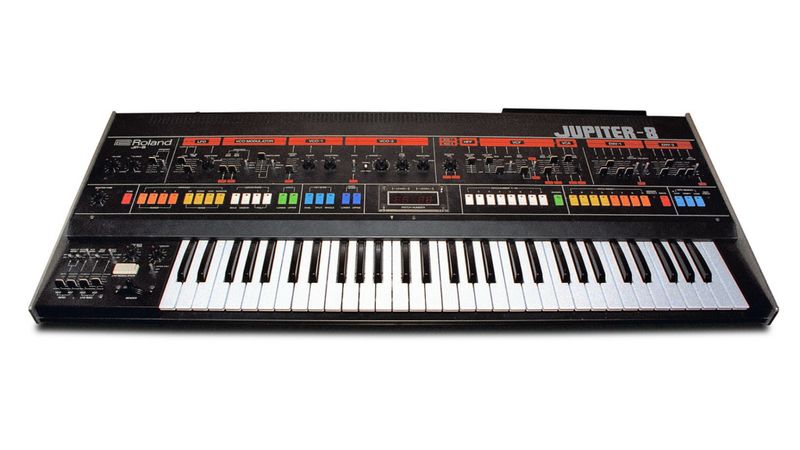
The Roland Jupiter-8 is widely regarded as one of the greatest polyphonic analog synthesizers ever made. Introduced in 1981, it was Roland's flagship instrument and the first to offer eight voices of polyphony with two oscillators per voice, delivering a massive, lush sound that defined an era of synth-pop, new wave, and electronic music. Decades later, the Jupiter-8 remains a benchmark for analog warmth, and its pads, brass, and string sounds are still referenced as the gold standard.
Dual Oscillator Architecture
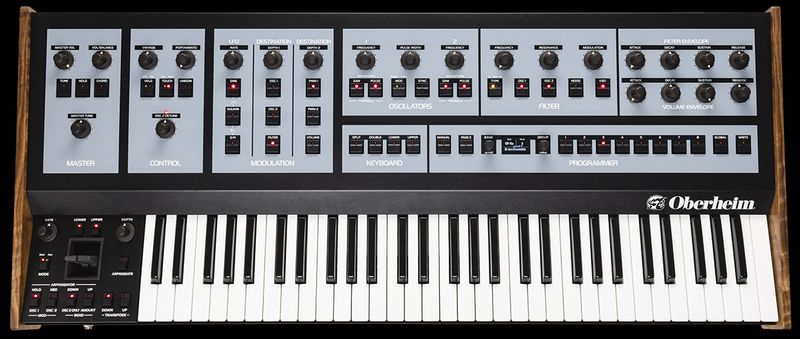
Each of the Jupiter-8's eight voices features two voltage-controlled oscillators offering sawtooth, square, pulse, and triangle waveforms, with noise available on the second oscillator. Pulse width modulation, oscillator sync, and cross-modulation give you a deep range of timbral options from a relatively straightforward signal path. The dual-oscillator design means you can detune for thick chorusing effects, hard-sync for aggressive leads, or mix waveforms for complex evolving tones. This is the foundation of the Jupiter-8's legendary richness.
Filters and Sound Shaping
The filter section includes a resonant low-pass filter switchable between 12dB and 24dB per octave slopes, plus a separate high-pass filter. The 12dB mode is particularly beloved for its smooth, open character, while the 24dB mode provides more aggressive, squelchy filtering. Dedicated ADSR envelopes for both the filter and amplifier, along with an LFO offering sine, triangle, ramp, and random waveforms, give you thorough control over how sounds evolve over time. Key follow, envelope modulation depth, and LFO routing are all available from the front panel.
Performance Features and Build
The Jupiter-8 supports keyboard splitting into upper and lower zones, each with independent patches, making it a bi-timbral instrument. A built-in arpeggiator and portamento add movement and expression. The 64 patch memories let you store and recall sounds instantly. Outputs include both balanced XLR and unbalanced 1/4-inch jacks for each split zone. Later production units included Roland's DCB interface for external sequencer control, though MIDI was not available on the original. At 22 kg, the Jupiter-8 is substantial but built to last, with a 61-key keyboard and a solid metal chassis.
Who Is This For?
- Serious analog synth collectors and enthusiasts seeking the pinnacle of Roland polyphonic design
- Producers who want the definitive vintage analog pad, brass, and string sounds
- Sound designers who need a versatile dual-oscillator polysynth with hands-on control
- Studios looking for a centerpiece instrument with unmistakable sonic character
The Jupiter-8 is among the most expensive vintage synthesizers on the market, with clean examples regularly selling for $10,000 to $20,000 or more. Roland offers a software Jupiter-8 through Roland Cloud for those who want the sound without the investment. The hardware remains a bucket-list instrument for a reason: its combination of warmth, presence, and musicality has never been fully replicated.
Videos
Frequently Asked Questions
Specifications
| Year Released | 1981 |
| Synthesis | Analog subtractive (VCO) |
| Polyphony | 8 voices |
| Oscillators | 2 VCOs per voice (saw, square, pulse, triangle, noise) |
| Keys | 61 |
| Filter | Resonant LPF (12dB/24dB switchable), HPF |
| Patch Memory | 64 presets |
| Outputs | Balanced XLR (L/R), 1/4-inch (L/R), Headphones |
| Dimensions | 1063 x 485 x 120 mm |
| Weight | 22 kg (48.5 lbs) |
Resources
Looking to Buy Used?
Browse current listings on Reverb and eBay to find deals.
Related Gear
More from Roland
Specs and prices are for reference only and may be outdated or contain errors. See full disclaimer. Affiliate links may earn commission.